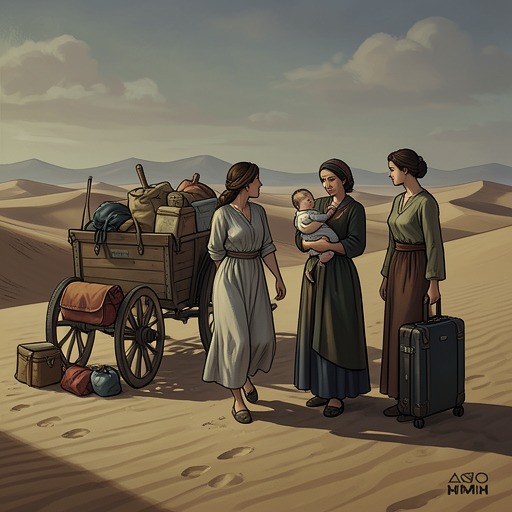
Lizzy Is Left by Her Father at the Santa Fe Convent
The StaircaseLizzy Is Left by Her Father at the Santa Fe Convent is the night-time separation that makes Lizzy Enders’s feared abandonment undeniable. She wakes to the sounds of a caravan preparing to leave, assumes her father has simply failed to wake her, and discovers that he has deliberately left her in the care of Mother Magdalena. The scene’s painful reversal lies in the difference between what Lizzy first sees—a departure she expects to join—and what it means: her father has already decided she will remain behind.
Night Departure and False Expectation
A long scream wakes Lizzy in the moonlit room. At first she wonders whether it is a coyote or someone keeping watch outside the wagon. Disoriented, she recognizes that she is no longer in the wagon but in a room with an old chifforobe and a window. Elinora is in bed, snoring, while Lizzy approaches the window and sees people moving through the moonlit streets of Santa Fe.
Below, the caravan is being made ready: the oxen are hitched and packs are put on the mules. The sight seems to confirm that her people are leaving before dawn, but Lizzy initially treats the departure as a misunderstanding. She imagines that arrangements were made after she fell asleep and that someone will soon come to wake her. Her first response is practical and hopeful: she must dress and catch up with the others. The preparations are real; her assumption that she is still included in them is not.
The Revelation
As the departure becomes harder to ignore, Lizzy pounds on the door and calls for her father. She accuses those around her of wanting her to stay and suspects that they arranged this with him. Her certainty that she can still join the caravan persists even as the scene gives her reasons to doubt it. The screams she hears seem to interrupt her attempt to make herself heard, until she realizes that the scream is her own.
Mother Magdalena has come to hold her. Lizzy recognizes the smell of a nun’s habit and sees the older woman’s stern face; the embrace briefly recalls the comfort she has not had since Mama died. That physical tenderness does not soften what Mother Magdalena tells her: Mr. Enders has not forgotten Lizzy. He has decided to leave her with them, believing this to be best, and could not tell her himself. The explanation confirms what Lizzy says she has known for days but has refused to acknowledge. The painful discovery is not that her father lost track of her, but that his absence is deliberate.
Resistance and the Caravan’s Departure
Even after the truth is stated, Lizzy asks Mother Magdalena to go outside and tell her father she is coming. She insists that he needs her and that she has to go with him to Colorado. Her appeal ties the immediate struggle to the relationship she believes she still has with him: she does not ask merely to leave the convent, but to remain necessary to her father. When that hope fails, she asks at least to go out and say goodbye, distressed that he did not say goodbye to her. Mother Magdalena answers that he could not.
Lizzy’s pleading is sharply at odds with the self-image she voices in the scene: she says that the Cheyenne and Blackfoot part of her never cries and that she has never begged for anything. The departure outside makes the decision irreversible in the moment. Shouts of “gee” and “haw” and “wo ho” reach the room as the caravan moves away. Lizzy hears the sounds and understands that they are leaving without her. Her scream rises again; Mother Magdalena holds her while she struggles, but Lizzy breaks free and strikes Elinora, shouting that she hates her. The outburst turns her pain outward, onto the girl who is present, while the father she is calling for is already departing.
Consequences and Narrative Significance
The scene changes Lizzy’s situation from uncertain travel to enforced separation. She had expected to go to Colorado with Mr. Enders and imagined that he needed her; instead, she is left at the convent without a goodbye she can accept. The timing intensifies the rupture: she learns the truth in the same night that the wagons, oxen, and loaded mules carry the departure into effect. There is no opportunity for a conversation with her father or for Lizzy to alter his decision.
The event also joins two losses in Lizzy’s response. Mother Magdalena’s embrace reminds her of the comfort she lost when Mama died, but the refuge offered by that embrace cannot substitute for the father who has gone. The scene does not present her anger as resolution; it is the immediate form her helplessness takes, first in accusations and pleas, then in the blow against Elinora. By making Lizzy hear the caravan leave after she has been told the truth, the narrative turns an unseen decision into an audible and bodily separation. Her belief that she has merely been forgotten gives way to the harder knowledge that she has been left behind.